Migratory Species and Wetlands: Insights from the Global Wetland Outlook 2025
Bonn, 21 July 2025 — Wetlands, which sustain life across the planet, are disappearing faster than any other ecosystem. Released earlier last week by the Ramsar Convention on Wetlands, the Global Wetland Outlook 2025: Valuing, conserving, restoring and financing wetlands (GWO 2025) warns that without urgent action, one fifth of the world’s remaining wetlands could vanish by 2050—an ecological loss with massive consequences for communities, livelihoods, and ecosystems.
Wetlands: Lifelines for Migratory Species
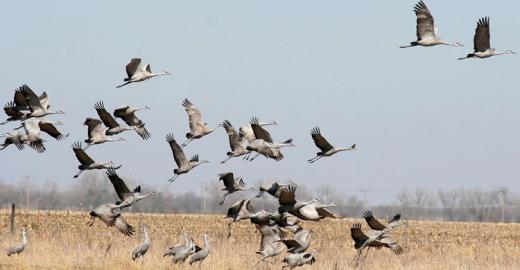
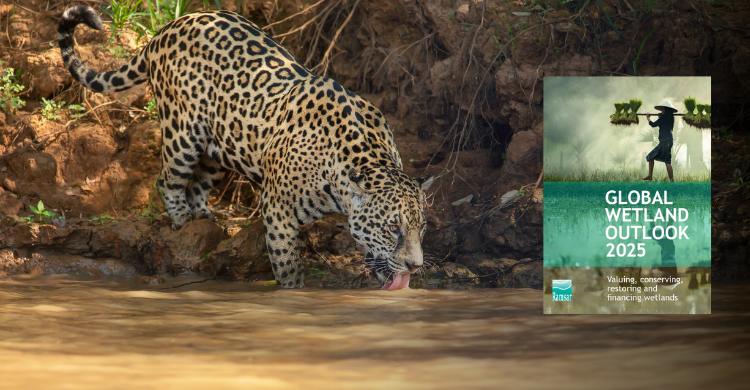
Wetlands are essential natural ecosystems that many migratory wild animals rely on to survive. While they are widely associated with migratory birds, providing critical stopover, breeding, and wintering habitats for migratory waterbirds and other species, their importance extends far beyond avian species. Wetlands support migratory fish such as eels that rely on seasonal flows and floodplain connectivity, and serve as critical habitat for mammals such as the jaguar (CMS App I and II). Also categorised as wetlands in the GWO, seagrass meadows, for example, are vital for migratory marine species such as turtles, dugongs, sharks and seabirds, while also acting as powerful carbon sinks and coastal stabilisers. Mangrove ecosystems, such as those in South Asia with the Sundarbans Forest– designated as Ramsar Sites, wetlands of international importance, and a UNESCO World Heritage Site – support millions of migratory birds, fish, and marine mammals such as the endangered Irrawaddy Dolphin (CMS App I and II). They also offer a buffer zone for biodiversity and human communities from rising seas and intensifying storms. Rivers and streams serve as essential corridors for migratory freshwater species, including fish and amphibians, and are critical to maintaining ecological connectivity.
Global Wetland Loss: A Stark Warning
The GWO found that since 1970, an estimated 411 million hectares of wetlands have been lost worldwide, representing a 22% decline in global extent and an average annual loss rate of 0.52% per year. This loss is particularly acute in regions such as Latin America, the Caribbean, and Africa, where wetland degradation has accelerated in recent years.
In Latin America, although the report does not name specific sites, it identifies the region as one of the most affected by wetland degradation. This context is particularly relevant for the Convention on Migratory Species as Brazil prepares to host the CMS 15th Meeting of the Conference of the Parties (COP15). The Pantanal—the world’s largest tropical wetland and a vital site for migratory species—exemplifies the challenges and opportunities described in the report. As a wetland dominated by inland marshes and swamps, the Pantanal is impacted by the same the global trends of wetland loss and degradation highlighted in the Global Wetland Outlook 2025.
The urgency of protecting these habitats is echoed in the findings of the CMS 2024 State of the World’s Migratory Species (SWMS) report, which revealed that nearly half of CMS-listed migratory species are in decline, and more than one-in-five are threatened with extinction. Habitat loss—particularly of wetlands—is cited as one of the primary drivers. The CMS report highlighted that 75% of CMS-listed species face threats from habitat degradation, underscoring the critical role of wetland conservation in reversing these trends.
Case Studies: Wetlands in Action
Although wetlands cover only 6% of the Earth’s land surface, they support around 40% of all known plant and animal species, making them extremely important for global biodiversity.
The African-Eurasian and East Asian–Australasian flyways, for example, depend on a network of wetlands that sustain millions of migratory waterbirds. The GWO2025 highlights the Regional Flyway Initiative in East and Southeast Asia, which aims to protect and restore over 140 priority wetlands supporting 50 million migratory waterbirds and nearly 200 million people. These wetlands are also vital to local communities, providing food, water, flood protection, and livelihoods.
In Africa, the Kafue Flats in Zambia exemplify the ecological and socio-economic value of wetlands. This 6,500 km² wetland supports the entire population of the endemic Kafue Lechwe and 30% of the global Wattled Crane (CMS App II and AEWA-listed) population. It also sustains 1.3 million people, 89% of Zambia’s sugar production, and 50% of its hydroelectric power. Restoration efforts, including invasive species removal and adaptive water management, have helped recover biodiversity and ecosystem services. The GWO 2025 notes that while full ecological restoration is no longer feasible due to altered hydrology, sustained investment and adaptive management can maintain a new balance of benefits.
The Global Wetlands Outlook report also emphasises the importance of integrating traditional knowledge into wetland monitoring and management. In New Zealand’s Whangamarino Wetland, the local iwi (tribe) of Waikato observed a three-week delay in the seasonal migration of eels (tuna heke), a culturally significant species. This delay, noted by elders using traditional ecological knowledge, signalled a disruption in hydrological cues and water quality—well before technical monitoring detected the issue. Such examples highlight the value of Indigenous stewardship in understanding and responding to ecological change.
Pathways to Recovery: GWO 2025 Recommendations
The GWO 2025 outlines four key pathways to reverse wetland loss and degradation:
- integrating wetland value into decision-making,
- recognising wetlands as part of the global water cycle,
- embedding wetlands in innovative financing mechanisms,
- mobilising public and private resources for restoration.
These pathways are identified as necessary steps for meeting the Kunming-Montreal Global Biodiversity Framework Targets. According to the report, achieving these targets involves restoring at least 123 million hectares of wetlands to address Target 2, which concerns the restoration of at least 30% of all degraded ecosystems, and conserving 428 million hectares of wetlands to fulfil Target 3, focused on the conservation of at least 30% of land, waters, and seas by 2030.
Looking Ahead: Ramsar COP15 and CMS COP15
For the Convention on Migratory Species (CMS), the findings of the GWO 2025 reinforce the urgency of protecting wetlands as critical habitats for migratory species. Together with the SWMS report, it provides a scientific foundation for aligning wetland conservation with climate, biodiversity, and sustainable development goals—an agenda that CMS Parties are well-positioned to advance.
As the international community prepares for the 15th Meeting of the Conference of the Contracting Parties to the Ramsar Convention on Wetlands (Ramsar COP15) in July 2025, and for CMS COP15 in March 2026, these findings offer timely guidance. Both COPs present critical opportunities to elevate wetlands on the global agenda and to catalyse coordinated action for the conservation of migratory species and the ecosystems they depend on.
Access the Global Wetlands Outlook 2025: https://www.global-wetland-outlook.ramsar.org/